
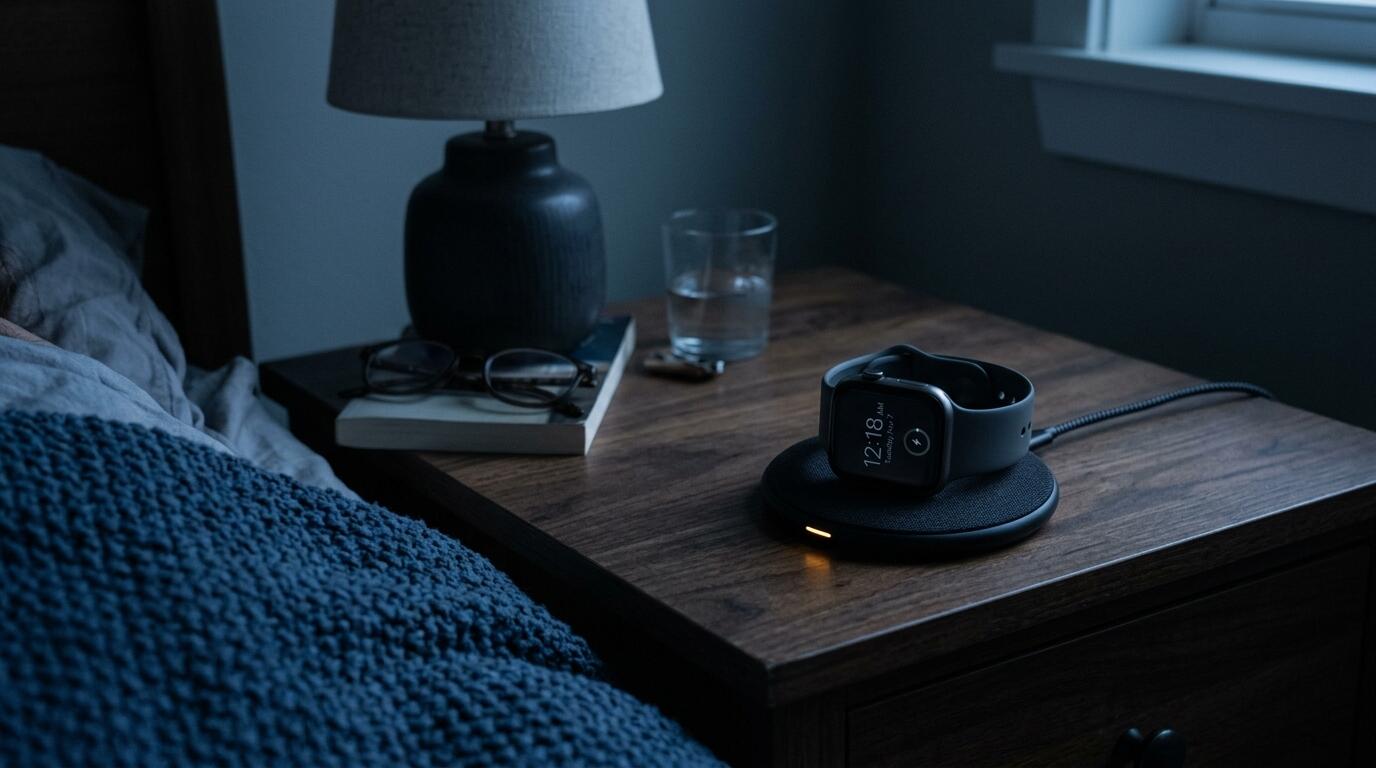
The weak point in a safety plan is often not the technology.
It is the ordinary human bit around it.
The watch is charging. The pendant is on the bedside table. The phone is in the kitchen. The hallway is dark. Someone gets up at 2am to use the bathroom, feels dizzy, and suddenly the whole plan depends on a device that is not on them.
That is the overnight gap.
The Watch Has to Be Worn
Apple Watch fall detection is useful technology. Apple says it can detect a hard fall while the person is wearing the watch, alert the wearer, and call emergency services if they do not respond.
That "while wearing your watch" part is the whole issue.
Most people charge a smartwatch at night. Some charge it while showering. Some forget it after a charge. Some take it off because it irritates their skin or because notifications become annoying.
None of that means the watch is bad. It means the watch is a daily habit, and daily habits break.
Apple's battery support is built around checking charge level, charging the watch, and using Low Power Mode when needed. That is normal for a smartwatch. It is also a real safety-plan constraint if the family is relying on it overnight.
Pendants Have a Different Problem
A pendant can avoid the daily charging problem, depending on the device. It can also be simple, which is a strength.
But the pendant has to be on the person or close enough to use.
Plenty of people take them off before bed, before showering, or when they get tired of feeling like a patient. Some leave them beside the bed because they do not want to sleep in them. Some agree to wear them when the family is there, then quietly stop.
That is not stubbornness. It is often a privacy and identity problem. Your parent may still feel capable. A pendant can feel like a public admission that they are no longer trusted to live alone.
You can disagree with that. You still have to design around it.
Night-Time Is Not a Special Case
Night-time problems are not rare edge cases in family life.
People get up for the bathroom. They get a drink. They answer the door. They check a noise. They wake up disoriented. They walk through a dark hallway while half asleep.
Healthdirect's falls guidance includes simple home changes like good lighting, turning lights on when walking around, and leaving hallway lights on at night. That advice is practical because night-time movement is part of the real risk.
The point is not to panic about 2am. The point is to stop pretending the safety plan only has to work during the neat parts of the day.
The Phone Is Not a Safety Plan
Many families default to the phone.
"She always has her phone."
Maybe she does. Until it is charging in another room. Or under a cushion. Or on silent. Or flat. Or on the bench because she was only walking to the bathroom for a minute.
A phone is excellent when someone can reach it, open it, and use it. It is weak when the problem has already happened.
That is why the overnight gap is hard. A lot of the obvious tools depend on the person being able to do something after the event.
What a Home Safety Net Can Cover
Puffin Guard takes a different approach.
It does not try to detect the fall itself. It does not sit on the wrist. It does not ask your parent to press a button.
It checks whether expected movement at home has happened. If the check is missed, it contacts your parent first. If they respond, nothing escalates. If they do not respond, their trusted contacts get a call.
That makes it slower than a watch or pendant when those devices are worn and working.
It also means it keeps working when the watch is charging, the pendant is off, and the phone is in another room.
That is the tradeoff.
A Better Overnight Plan
Do not make the plan depend on one device.
For an independent parent living alone, a practical overnight plan might include:
- a clear path from bed to bathroom
- hallway or motion lighting
- shoes or slippers that do not slide
- phone charging in the bedroom if they will accept it
- a wearable if they will actually wear it overnight
- a passive home safety net if a wearable is not realistic
- a clear rule for what family should do if they cannot be reached
The last point matters.
If your parent does not answer at 8am, what happens?
Do you call again? Wait an hour? Ring a neighbour? Drive over? Call police for a welfare check? Who decides?
That is the part most families leave vague until they are stressed.
Watches, Pendants, and Puffin Guard Can Work Together
This is not about choosing a team.
If your parent likes their Apple Watch or pendant, keep it. Fast response is valuable when the device is worn, charged, connected, and accepted.
Use Puffin Guard for the part those devices often miss: the home gap when normal movement has stopped and the wearable is not there to help.
If your parent refuses a wearable completely, start with the option they might accept. A shelf sensor is less confronting than a device on the body. It does not solve every problem, but it can close a real gap without asking them to change their daily routine.
The Question to Ask
Do not start with "what device should we buy?"
Start with this:
If something happened between bedtime and breakfast, when would someone know?
If the answer depends on a watch being worn, a pendant being accepted, or a phone being reachable, then you have an overnight gap.
That is the gap to close.
Use the checklist to map it properly: The Parent Living Alone Safety Checklist.
Related guide: Daily check-in without daily texts.
Sources: Apple Support: Use Fall Detection with Apple Watch, Apple Support: Check your battery and charge your Apple Watch, and Healthdirect: Older people and falls.