
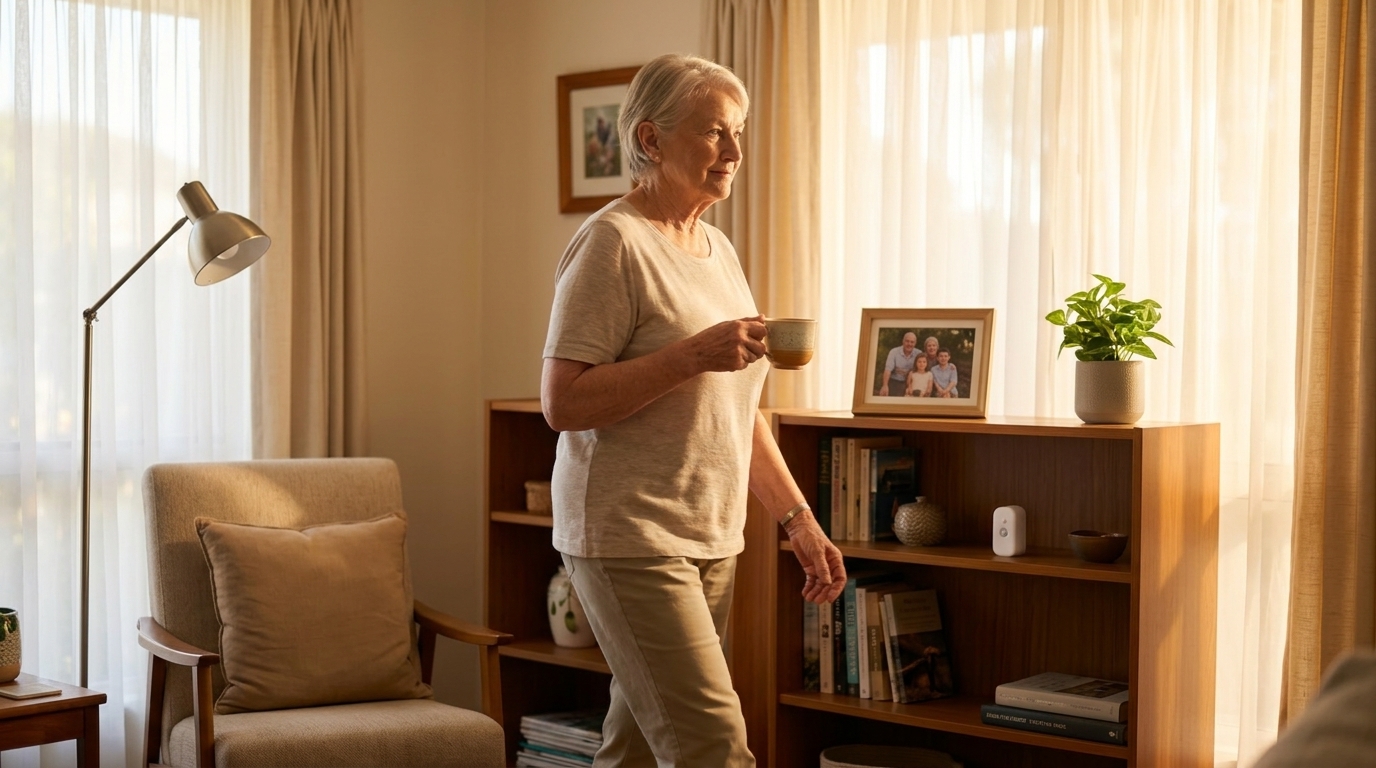
If you are looking for a way to know your parent is OK without cameras, you are probably trying to solve two problems at once.
You want someone to know if something goes wrong.
You also do not want your parent to feel watched in their own home.
That second part matters. It is not a small preference or a marketing angle. It is the difference between a safety system your parent can live with and one they quietly unplug.
Cameras Solve One Problem and Create Another
An indoor camera gives visual certainty. That can be useful in some situations, especially where the person living at home needs close supervision and accepts that level of support.
But for a capable parent who still values privacy, a camera changes the room.
They know it is there while they eat breakfast, watch TV, sit in silence, or have a bad day. Even if nobody is checking constantly, the possibility is enough to change how home feels.
The Office of the Australian Information Commissioner explains that security cameras can collect personal information when a person is reasonably identifiable. That does not mean every family camera is illegal. It does mean video is not neutral. It is personal information with real privacy weight.
Privacy-First Safety Starts With Collecting Less
The simplest privacy test is this:
What does the system collect when nothing is wrong?
A camera collects images. A microphone collects sound. A room-by-room activity system can create a detailed pattern of daily life.
A privacy-first safety net should collect the smallest useful signal.
For Puffin Guard, the useful signal is expected movement. Has there been movement at home during the agreed check window? If yes, nothing happens. If no, the system checks in with the person first before alerting trusted contacts.
No video. No sound. No family activity feed. No room-by-room dashboard.
That is a deliberate product decision. The family does not need to know what your parent did all day. They need to know if the ordinary safety signal is missing and your parent cannot answer.
Ask These Five Questions Before Choosing
If a product says it is private, ask what that means in plain terms.
- Does it record video?
- Does it record audio?
- Can family see a daily activity timeline?
- Does it contact the person first before alerting others?
- Can the person living alone pause it or control it?
Those answers matter more than the word "private" on the page.
My Aged Care says people receiving government-funded aged care have the right to be treated with dignity and respect. The Aged Care Quality and Safety Commission also has a strengthened quality standard for dignity, respect and privacy. Even if your family is not dealing with formal aged care, the principle is useful: safety should not erase the person's dignity.
What Puffin Guard Does Not Show You
Puffin Guard does not show you:
- what room your parent is in
- what they are doing
- when they made tea
- whether they watched TV
- whether they slept in
- live video
- recorded video
- audio
- a daily activity feed
That can feel strange at first because a lot of "monitoring" products are built around giving the family more visibility.
Puffin Guard is built around a narrower promise.
If expected movement happens, leave everyone alone.
If expected movement does not happen, ask your parent first.
If they cannot answer, tell trusted contacts.
That is the safety net.
When Cameras Are the Right Choice
There are situations where cameras or more detailed monitoring may be appropriate.
That might include severe cognitive decline, repeated unsafe incidents, care teams that need visual confirmation, or a person who actively wants that setup.
Puffin Guard is not for those situations. It is not 24/7 supervision. It is not clinical monitoring. It is not a substitute for care.
It is for the parent who is mostly managing, still wants their own space, and would accept a quiet backup if normal movement stopped for too long.
The Better Question
Instead of asking, "How can I monitor my parent without cameras?", ask this:
What is the least information we can collect while still closing the time gap?
For some families, the answer will still be daily calls, home care, a pendant, or a watch.
For others, it is a small home sensor that only speaks up when something may be wrong.
That is what privacy-first safety means. Not no risk. Not no responsibility. Less watching, less data, and a clearer reason to alert someone.
Start with the checklist: The Parent Living Alone Safety Checklist.
Related guide: Elderly monitoring without cameras.
Sources: OAIC security cameras guidance, OAIC: What is privacy?, My Aged Care: Know your rights, and Aged Care Quality and Safety Commission: dignity, respect and privacy.