
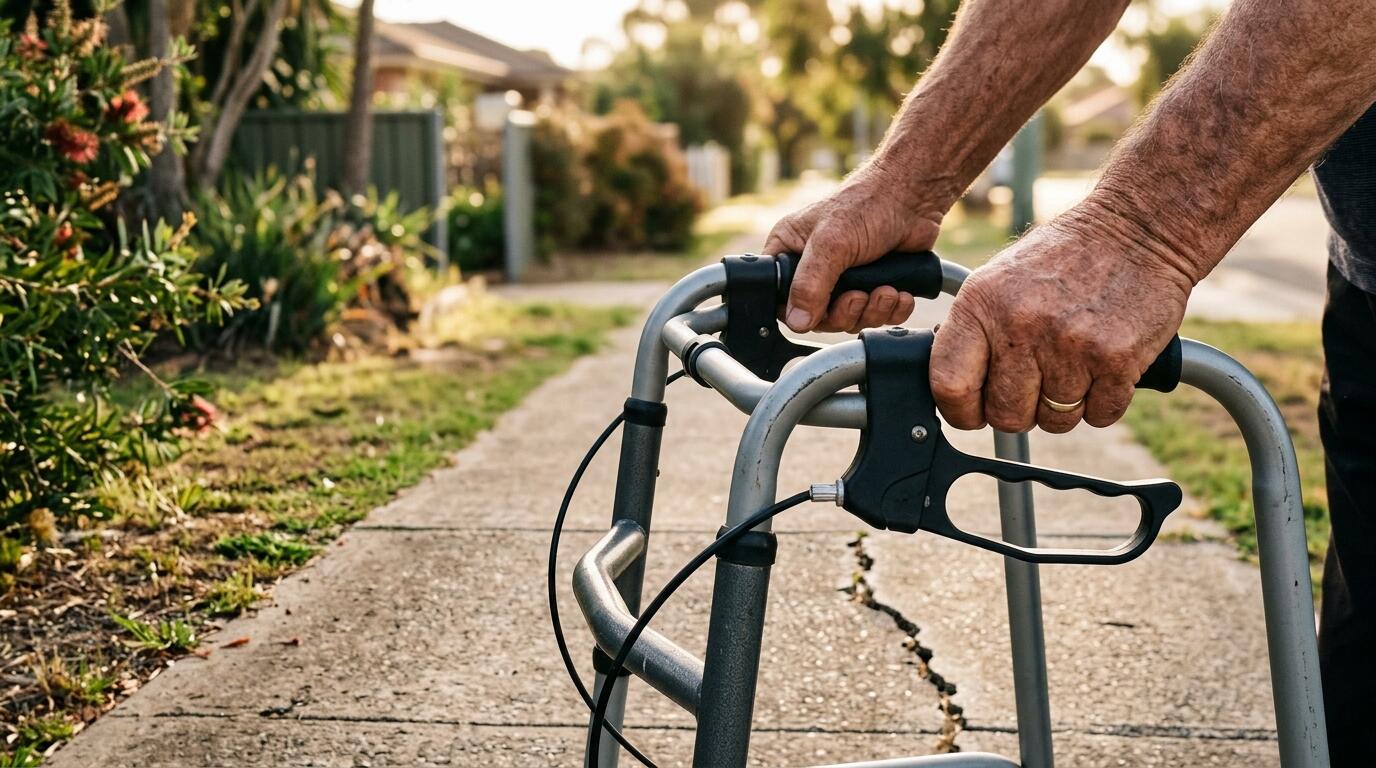
If you're researching safety for a parent living alone, you've probably encountered vague statistics about falls. "Falls are the leading cause of injury in older Australians." True, but what does that actually mean for your family?
Here's what the data says, sourced primarily from the Australian Institute of Health and Welfare falls data, Healthdirect's falls advice, the Australian Commission on Safety and Quality in Health Care Falls Guidelines, and Australian population projections.
How Common Are Falls?
About one in four Australians aged 65 and over has at least one fall each year, according to Healthdirect.
The AIHW's current national falls data shows the age effect clearly. In 2024-25, people aged 65 and over were hospitalised for falls 12 times more often than adults aged 25 to 44.
The practical point for families is not whether the annual number is 130,000 or 140,000. It is that fall hospitalisations in older age are common enough that every family with a parent living alone should have a plan for what happens after a fall.
Who Is Most at Risk?
Falls aren't evenly distributed. Several factors significantly increase risk:
Age. The fall rate roughly doubles between the 65-74 age group and the 85+ age group. The older your parent is, the higher the risk.
Living alone. People who live alone are not necessarily more likely to fall, but they're significantly more likely to experience a long lie, where they remain on the floor for an extended period because nobody is there to help. The consequences of a long lie are often more serious than the fall itself.
Previous falls. Having fallen once is one of the strongest predictors of falling again. A person who has fallen in the past 12 months is two to three times more likely to fall again.
Medication. Certain medications, particularly sedatives, antidepressants, and blood pressure medications, significantly increase fall risk. Polypharmacy (taking multiple medications) compounds the risk further.
Home hazards. Loose rugs, poor lighting, uneven surfaces, cluttered hallways, and slippery bathrooms are involved in a significant proportion of falls. The Australian falls guidelines include home safety, footwear, vision, medications, balance, and mobility as practical risk areas to work through. Many of these are straightforward to fix.
Reduced mobility and strength. Age-related muscle loss (sarcopenia) affects balance and the ability to recover from a stumble. Regular exercise, particularly balance and strength training, is one of the most effective fall prevention strategies.
What Happens After a Fall?
Not every fall results in serious injury. In fact, most don't. But the ones that do can be devastating.
Hip fractures are the most serious common fall injury. Australia has one of the highest hip fracture rates in the world. Approximately 20,000 Australians suffer a hip fracture each year, with the vast majority occurring in people over 65. Around 5-8% of people who suffer a hip fracture die within 30 days. Up to 30% die within 12 months.
Head injuries from falls are the second major concern. Subdural haematomas (bleeding between the brain and skull) can develop slowly after a seemingly minor bump, sometimes not causing symptoms for days or weeks.
Soft tissue injuries (bruises, sprains, cuts) are the most common outcome. These are usually manageable, but for older adults taking blood thinners, even minor cuts and bruises can become serious.
Loss of confidence. After a fall, many older adults develop a fear of falling again. This leads to reduced activity, social withdrawal, and a downward spiral of declining strength and increasing isolation. Research suggests that up to 50% of older adults who fall develop a fear of falling, and many reduce their activity levels as a result, even if they weren't seriously injured.
The Time Gap Problem
Here's the statistic that matters most for families: it's not the fall that determines the outcome. It's how long the person is on the floor.
Research consistently shows that lying on the floor for more than one hour significantly increases the risk of complications including dehydration, hypothermia, rhabdomyolysis (muscle breakdown), and pressure injuries. After 12 hours, the risk of death within six months roughly doubles, regardless of the severity of the original fall.
For people who live alone, the average time to discovery after a fall is significantly longer than for those who live with someone. This is the fundamental problem that safety solutions are trying to solve.
A smartwatch with fall detection can respond in seconds, but only while it's being worn and charged. A pendant only helps if the person is wearing it and can press the button. A daily phone call only detects the problem at the next scheduled call. A neighbour only helps if they happen to visit. We've written in more detail about why the time gap matters and what families can do about it.
The Aging Population Context
These numbers are going to get worse. Australia's population is aging rapidly.
The number of Australians aged 85 and over, the highest-risk group for falls, is growing quickly. The ABS has projected the 85-plus population to double by 2042, and Treasury's 2023 Intergenerational Report says the number of Australians aged 85 and over will more than triple over the next 40 years. The number of people living alone in older age is also increasing, driven by longer life expectancies, changing family structures, and the desire to age in place.
More people at higher risk, living alone, with family members who are further away. The gap between "something happens" and "someone knows" is widening for many Australian families.
What the Data Suggests
The evidence points to a few clear conclusions:
Falls are common and largely unpredictable. You can reduce the risk through home modifications, exercise, medication reviews, and good footwear. But you can't eliminate it. Every family with a parent over 65 should have a plan for what happens if a fall occurs, as well as how to prevent one.
The time gap is the controllable factor. You can't prevent every fall, but you can control how quickly help arrives. Solutions that reduce the time between a fall and discovery, whether that's a pendant, a daily check-in, or a passive safety net, directly improve outcomes.
Compliance determines effectiveness. The best safety solution is the one your parent will actually use. A pendant in a drawer, a camera that gets unplugged, or a check-in app that gets ignored provides zero protection while giving the family a false sense of security. If you're evaluating options, we've written a realistic guide to all the approaches.
Layered approaches work best. No single solution covers every scenario. The families with the best outcomes tend to combine multiple approaches: fall prevention (exercise, home modifications), a way to call for help (smartwatch, pendant, or phone), and a background safety net that works even when everything else fails.
Puffin Guard is a daily safety net, not an emergency response device. A single sensor detects everyday movement. No cameras, no wearables, no buttons to press. If expected movement isn't detected, we reach out to your parent first. If they can't respond, we call the people they trust. It won't catch a fall in seconds, but it means someone finds out, not days later. See how it works →
Sources: AIHW Injury in Australia: falls, Healthdirect falls advice, Australian Commission on Safety and Quality in Health Care falls guidance, ABS population projections, and the 2023 Intergenerational Report factsheet.
Puffin Guard is a private safety net for people living independently. One sensor, no cameras, no wearables. Learn more.