
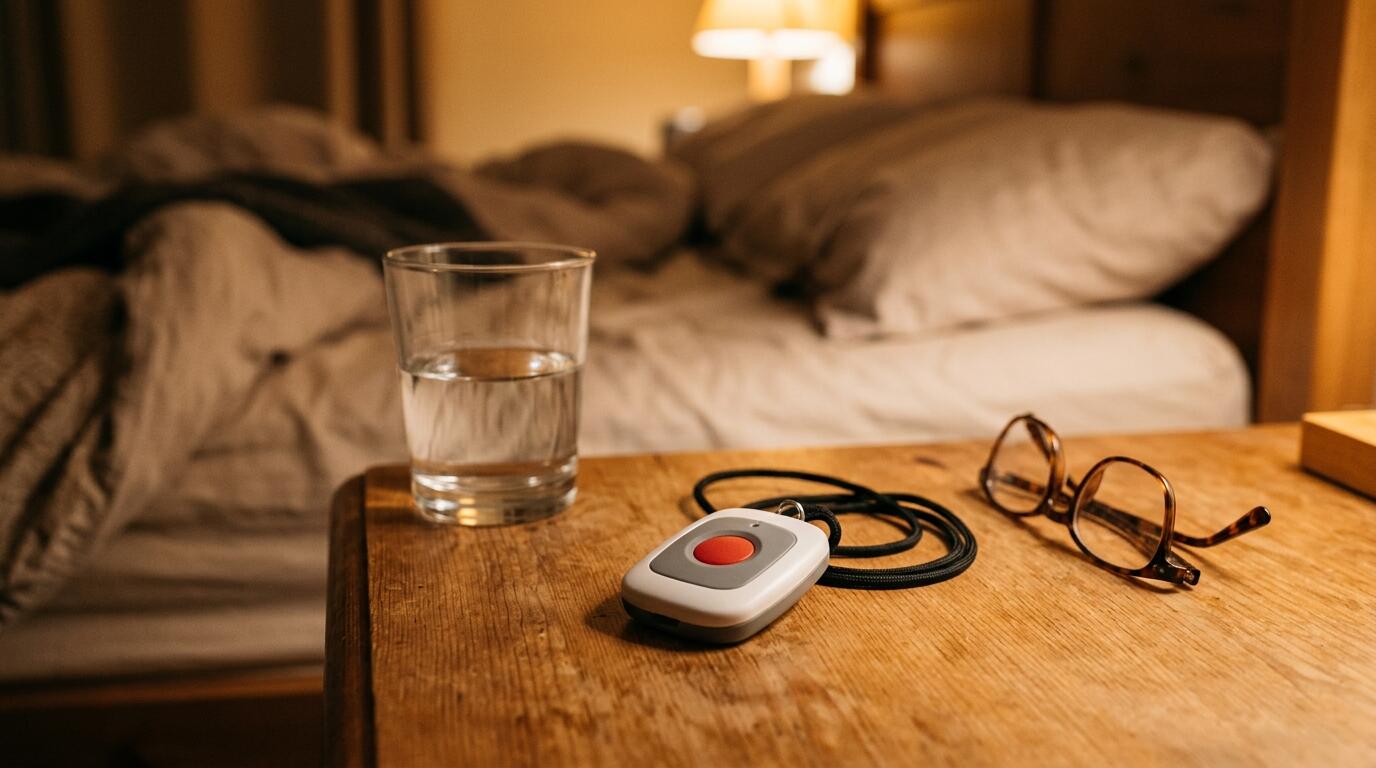
If you've started researching safety options for a parent living alone, you've almost certainly come across medical alert pendants. They're the default recommendation. GPs suggest them. Aged care services recommend them. Your friends probably have a parent with one.
And for some families, they're exactly the right solution. But for many others, they're not, and the families who buy one expecting the worry to go away end up with a device in a drawer and a false sense of security.
Here's how to figure out which camp your family is in.
How Medical Alerts Work
The basic concept hasn't changed much in decades. Your parent wears a device, usually a pendant around their neck or a watch on their wrist, with a button they can press in an emergency. Pressing the button connects them to a 24/7 monitoring centre, which can dispatch help or call their emergency contacts.
Newer models add features like automatic fall detection, GPS tracking, and two-way communication. Some are waterproof. Some look like regular watches. The technology has improved significantly, but even the best wearable still depends on the person accepting it and keeping it on.
The monthly monitoring fees vary by provider and plan, so check the current price, contract length, cancellation terms, and whether fall detection, GPS, or cellular service costs extra.
When a Medical Alert Is the Right Choice
A pendant or watch is a good fit when:
- Your parent is willing to wear it. Not "willing to try it," but genuinely committed to wearing it every day, including at night, in the shower, and in the garden.
- They're at high risk of a specific event. If your parent has a heart condition, a history of falls, or a medical situation where they might need to call for help urgently, the ability to press a button and reach a monitoring centre in seconds is genuinely valuable.
- They're cognitively able to use it. Pressing a button during an emergency requires the presence of mind to remember the device, locate the button, and press it. For someone with significant cognitive decline, this may not be reliable.
- They want the reassurance. Some parents genuinely like having a pendant. It makes them feel safer. If your parent is one of them, that's the best possible outcome.
If all four of these are true, a medical alert pendant or watch is probably the right primary solution for your family.
When It's Not the Right Choice
This is where most families get stuck. The pendant is the recommended option, but the reality doesn't match the recommendation.
The compliance problem. This is the biggest issue, and it's well-documented. Studies consistently show that a large proportion of people who have medical alert pendants don't wear them consistently. They take them off to shower, sleep, or garden. They leave them on the nightstand. They forget. They feel self-conscious. Over time, the pendant migrates from "around their neck" to "in a drawer."
A family shared a story with us. Their father had a fall watch. He got up in the middle of the night, fell between his bed and the wall, and wasn't found for days. He was alive, but his watch was on the bedside table charging. The system designed to protect him only worked when he was wearing it.
The charging problem. Fall detection watches need daily or nightly charging. Unlike a simple pendant (which uses a coin battery), watches need to be taken off, placed on a charger, and put back on. Every night, your parent is unprotected during the charging period, which is exactly when middle-of-the-night falls are most likely.
The refusal problem. Many older adults simply won't wear one. It's not stubbornness. Wearing a medical device is a daily reminder of vulnerability. For a parent who still feels independent and capable, a pendant feels like a label. If your parent has refused, we've written about what to do when your parent refuses to be monitored.
The button-press problem. Medical alerts are designed around pressing a button during an emergency. They do this well. But some emergencies, a stroke, a loss of consciousness, a fall that leaves someone dazed, are precisely the situations where pressing a button isn't possible. Automatic fall detection helps, but it has a significant false alarm rate (triggered by sitting down heavily, dropping the device, or bending over quickly) and a significant miss rate (not all falls produce the sharp deceleration pattern the algorithm expects).
The psychological cost. Even for parents who wear the pendant, there's an ongoing psychological toll. Every morning, putting it on is a small reminder: I might need this today. For some parents, that's fine. For others, it quietly erodes their sense of independence.
The Middle Ground Most Families Miss
The conversation is usually framed as: medical alert or nothing. But there's a middle ground that's often a better fit.
Use both. A medical alert pendant or watch for acute emergencies (when your parent can press the button), and a passive safety net for everything the pendant can't cover: the times it's not being worn, the times they can't reach it, the times they're unconscious or too disoriented to use it.
This layered approach means your parent has an active system for emergencies they can respond to, and a background system for the ones they can't.
Use a passive safety net alone. For parents who refuse to wear a pendant, a passive safety net is often the only solution they'll accept. It doesn't require them to wear anything, charge anything, or press anything. It detects everyday movement in the home and only alerts their family if expected movement isn't detected. Nothing to refuse means nothing to abandon.
We've written a detailed comparison of all the options if you want to see how pendants, watches, cameras, smart home devices, and passive sensors compare side by side. There is also a shorter page for people specifically looking for a medical alert alternative in Australia.
How to Decide
Ask yourself these questions honestly:
Will my parent wear it every day? Not "would they agree to try it," but will they genuinely wear it at 2am when they get up for the bathroom? If the honest answer is no, a pendant won't protect them when they need it most.
Is my parent at risk of events where they can't press a button? Falls that cause unconsciousness, strokes, or severe dizziness. If yes, an automatic fall detection model helps, but it's not reliable enough to be your only safety layer.
Has my parent already said no? If they've refused once, they'll likely refuse again. Pushing harder damages the relationship. Look for solutions that don't require their active participation.
What's the time gap? If something happened right now, how many hours before someone would know? A pendant reduces the gap if your parent is wearing it and can use it. A passive safety net reduces the gap regardless.
The best answer is often "both." The realistic answer depends on what your parent will actually accept.
Puffin Guard is a passive safety net. No button to press, nothing to wear, nothing to charge. It detects everyday movement and only contacts you if something seems wrong. Many families use it alongside a pendant or watch. See how it works →
Sources and further reading: Healthdirect falls advice, Australian Commission on Safety and Quality in Health Care falls guidance, Apple Support: Use Fall Detection with Apple Watch, and Samsung Australia: Activate Hard Fall Detection on my Samsung Watch.
Puffin Guard is a private safety net for people living independently. One sensor, no cameras, no wearables. Learn more.